Quick look — your day-one checklist
- Read this whole guide first
- Fill out your Beginning Assessment
- Take your before pictures
- Set up your food + walking tracker apps
- Grab your favorite water bottle
- Open your challenge app and plan day one (Chapter 21)
- Screenshot your 8 Promises list (Chapter 22)
- Take it one day at a time
- Remind yourself you've got this
- And actually have fun with it
Chapter 1
Welcome — this one is different
If you've tried a challenge before, you probably know the drill. Day one arrives and suddenly you're supposed to:
- hit 10,000+ steps
- strength train 5 days a week
- track everything perfectly
- cut entire food groups
- buy a shelf of supplements
- overhaul your whole life
By Thursday you're exhausted, behind, and quietly deciding you'll start over Monday. Not because you're lazy. Because nobody can sustain six changes at once while also being a human with a job, a family, and a life.
This challenge starts smaller on purpose.
We build momentum first. Then we layer. The goal is not six weeks of perfection — it's six weeks of repeatedly showing up for yourself.
You are not expected to do this perfectly. You are expected to keep coming back.
Chapter 2
Hi, I'm Chelsi
A few years ago I went through thyroid cancer, and the season that followed changed almost everything — my health, my weight, my energy, my confidence, my routines. Slowly, without really deciding to, I stopped taking care of myself.
When I first started walking again, it wasn't because I suddenly felt motivated. I needed one reason to get out of bed that was FOR ME.
So I went back to basics. Not a program. Just the fundamentals:
- food
- walking
- hydration
- simple habits
- grace
- consistency
That's what created momentum. Since then I've lost 30+ pounds and I'm still going — still walking, still learning, still having imperfect weeks.
Chapter 3
What to expect
Here's everything the next six weeks includes — and nothing it doesn't.
Your walking path
Beginner or Intermediate — you choose.
Gradual progression
Each week builds on the last. No leaps.
Morning Reset™
10 gentle minutes to start the day for you.
The Layer Method™
We don't overhaul. We layer.
Finish Line Five™
A short ritual to end designated walks.
Exercise Snacks
Tiny bursts of movement through the day.
3-3 Momentum Walk™
Japanese interval walking: 3 minutes easy, 3 minutes brisk.
Two rest days weekly
One weekday, one weekend. Planned.
A realistic deficit
Whole-food meals your family can eat too.
Daily habits
Water, protein, 10 minutes for you.
Tracking + weekly checks
Data, not judgment.
Community + prizes
Accountability, weekly prizes, real support.
No formal strength training required. On purpose.
First we build movement, consistency, nutrition habits and confidence. Strength gets layered in later, when you're ready for it — not while you're still rebuilding the habit of showing up.
And don't worry — we still protect your muscle here, with enough protein and daily Exercise Snacks.
To be clear: strength training matters. It's huge for fat loss, metabolism, hormones and building muscle. But you can't out-train sloppy eating habits and inconsistent movement — so we start where the results actually come from.
At the end of the six weeks I'll show you how to add strength training without adding a single extra minute to your schedule — what to swap, how often, and when you're ready for it.
Chapter 4
The 8 Promises You're Making to Yourself
Not rules. Not a contract. Eight small commitments, made to the one person who usually gets left off the list.
Promise 1
Hydrate
Drink 100 oz of water daily.
Spread it out across the whole day. Chugging 60 oz at 9pm is a recipe for a bad night's sleep, not hydration. Keep a bottle where you actually sit.
Why electrolytes matter
Water alone isn't always hydration. When you're drinking 100 oz a day, sweating on walks and eating fewer processed foods, you flush out sodium, potassium and magnesium too. That's often what's behind the afternoon headache, the "I drank so much water and still feel foggy" days, the leg cramps, the dizziness when you stand up, and that weird fake hunger.
- Helps the water you drink actually get absorbed
- Steadier energy — fewer 3pm crashes
- Fewer headaches, cramps and lightheaded moments
- Cuts down on false hunger that's really thirst
- Better walks and easier recovery, especially in heat
The one I actually use is Instant Hydration — my current favorite is the premium electrolyte drink mix in LUIGI's Lemon Italian Ice.
Shop my electrolytes →Promise 2
Remove liquid sugar
For six weeks, sugary drinks step aside.
Swap sugary sodas, juices, sweetened coffee drinks and sugary creamers for water, unsweetened options, zero-sugar alternatives, or lower-calorie versions of what you love.
My favorite protein coffee duo
- ☕ Caramel Protein Instant Iced Coffee (Javvy)
- 🥛 Salted Caramel Protein Creamer (Javvy)
Promise 3
Skip the alcohol
No alcohol for the six weeks.
This is a temporary experiment, not a moral position. It removes liquid calories and gives you a clean look at your sleep, appetite, energy, recovery, decision-making and overall consistency without it.
Promise 4
Create your deficit
Aim for roughly a 500-calorie daily deficit (starts week 2).
Based on your estimated needs and a sensible minimum intake. Bigger is not automatically better — a huge deficit usually buys you hunger, low energy and a shorter streak. The calculator ahead gives you a starting point.
Promise 5
Eat mostly whole foods
About 80% whole or minimally processed.
Chicken stir fry with vegetables and rice is a different lunch than a protein shake plus a protein bar — even at the same calories. The other 20% is real life, and it still counts toward your target. Inside that 80%, aim for 2–3 servings a day of foods that support fullness, fiber and steady blood sugar. And aim for 30+ grams of protein per meal, with at least 3 real meals a day — that's what keeps you full, protects your muscle, and stops the 4pm hunt for snacks.
Promise 6
Complete today's movement
Whatever your challenge app assigns.
That might be your walk, the Morning Reset™, Exercise Snacks, the Finish Line Five™, or a 3-3 Momentum Walk™. Open the app, do the thing, close the app.
Promise 7
Take 10 minutes for you
Ten minutes a day that are completely yours.
Sit outside. Journal. Read. Drink your coffee alone. Stretch. Take a bath. Sit quietly. Listen to music. Make something. It doesn't have to be productive.
You deserve to be on your own list again.
Promise 8
Respect your rest
Two intentional rest days every week — and 8 hours of sleep a night, minimum.
One rest day during the workweek, one on the weekend. Keep your nutrition and hydration, keep living your normal life — just no scheduled challenge walk. Morning Reset™ is optional. Guilt is not invited.
Rest is part of the plan — not a break from the plan.
Aim for 8 hours, minimum
Sleep is the quietest fat loss tool you have. Short nights raise hunger hormones, tank your willpower by 3pm, and make your walk feel twice as hard. If you only fix one thing this week, fix bedtime.
- Pick a bedtime and work backwards — 8 hours before your alarm
- Phone down an hour before bed (it's the scroll, not the tiredness, keeping you up)
- Cut caffeine after about 2pm
- Dim the lights and cool the room down in the last hour
- Same wake-up time, even on weekends
- Keep the phone charging across the room, not on your pillow
- Something boring and analog before bed: a book, a stretch, a shower
Chapter 5
Mindset First: Action Before Motivation
This is the chapter that decides whether week three happens.
Action > Motivation
Waiting to feel motivated keeps a lot of women stuck for years. Motivation is not the starting gun — it's often the reward.
I didn't start walking because I woke up inspired. I started because I needed one thing in the day that was mine.
Stop waiting for Monday
The all-or-nothing cycle sounds like: it's ruined, I'll restart Monday. But one restaurant dinner doesn't require a Monday. One missed walk doesn't erase a week. One hard day is just one hard day.
Grace is not quitting
Giving yourself grace doesn't mean abandoning your goals. It means adjusting — so an imperfect day doesn't turn into an abandoned week.
Consistency > perfection
The goal was never 42 perfect days. The goal is learning how to keep going after an imperfect one. That skill outlasts every challenge you'll ever do.
About those scale fluctuations
Your weight can move day to day because of:
- hydration
- sodium
- carb intake
- digestion
- hormonal cycles
- changes in activity
- normal daily variation
None of that is fat gained overnight. It's a body doing body things.
The "whoosh" effect
You'll hear people talk about a "whoosh." Here's the honest version: fat loss and scale weight don't always move at the same speed. Temporary water retention can mask changes for a while, and then the scale drops noticeably when fluid balance shifts. It isn't a guaranteed scientific event — it's a pattern lots of people notice.
Here's the way I explain it: when your body is getting ready to release fat, the fat being emptied out of the cell gets replaced with water for a while. So the space is still there, still weighing the same on the scale — which is why you can do everything right and see nothing for a week or two. Then your body finally lets that water go, and suddenly you're down 5 pounds seemingly overnight.
Do not quit right before that happens.
Most women quit in the flat part — the exact stretch that comes right before the drop.
Signs it's working, even when the scale is quiet
- Real hunger cues showing up again — this is not a problem, it's your metabolism firing back up after years of being under-fed or over-caffeinated
- Feeling warmer, especially hands and feet (your thermostat coming back online)
- Waking up before your alarm, or sleeping harder and deeper
- Energy that lasts past 3pm without a second coffee
- Clothes fitting differently before the scale moves — waistbands, sleeves, rings
- Less bloating and more regular digestion
- Faces and shoulders looking leaner first (it never starts where we want it to)
- Walks feeling easier at the same pace, or your heart rate lower at the same speed
- Fewer sugar crashes and less late-night snacking pull
The protein effect
Getting adequate protein tends to:
- support fullness so meals actually satisfy you
- help preserve lean tissue while you're in a deficit
- support recovery from your walks
- make food more satisfying, not just lower calorie
- use slightly more energy to digest than carbs or fat
You don't need extreme amounts. You need enough, spread across the day.
Every walk you finish is another piece of evidence: “I am becoming someone who takes care of herself.”
Chapter 6
The Identity Chapter
Before we talk numbers again, we have to talk about who you're becoming — because that's the part that actually holds.
Start with a picture of her
Close your eyes for a second and see the version of you that already lives this way. Not a different face. Not somebody else's body. You — rested, strong, dressed in something you feel good in, walking because you like how it makes you feel. Watch how she moves through her day. What does she eat for breakfast? How does she talk to herself when something goes sideways?
That woman isn't a fantasy. She's you with different daily habits. Everything in this playbook is just the bridge.
Stop bullying the woman you're trying to help
You would never speak to your best friend, your daughter or your sister the way you speak to yourself in the mirror. And here's the thing nobody tells you: shame has never once produced consistency. It produces hiding. It produces starting over on Mondays.
Abandoning yourself is not a flex. Skipping meals isn't discipline. Running on three hours of sleep and a caffeine drip isn't strength. Being the woman who takes care of everyone but herself isn't a personality — it's exhaustion wearing a badge.
Let the old identity go completely
"I'm just not a morning person." "I have no willpower." "I always quit around week three." Those aren't facts about you. They're old lines you kept repeating until they felt like facts.
You're allowed to put them down. Not fix them, not argue with them — drop them. She doesn't come with you into this.
Change the lens
I have to walk today.
I get to move my body today.
This is going to be hard.
This is going to be easy.
I'm starting over again.
I'm continuing.
I need to lose weight.
I'm coming back to myself.
Tell yourself it's going to be easy. Out loud, even if you don't believe it yet. Your brain takes instructions surprisingly well. Tell yourself you're becoming the woman you've been craving to get back to — and then go do one small thing that proves it.
It doesn't have to be pretty
Some mornings I wake up, don't change out of my pajamas, don't brush my hair, and get on my walking pad exactly as I am. No cute outfit. No playlist. No perfect start time. It still counts. It counts the most, actually — those are the days that build the identity.
Waiting to do it perfectly is self-sabotage in a nicer outfit.
Perfect never starts on Monday. It just keeps promising to.
Small is the whole strategy
- More protein at the meals you're already eating
- High-volume meals so your plate stays full while calories come down
- Walking — pajamas, walking pad, driveway, whatever you've got
That's it. That's the starting point. Layer, don't overhaul.
Why "10 minutes for yourself" is a daily promise
One of your eight daily promises is ten minutes that belong only to you — and inside your challenge app, you'll be tracking what you actually did with those ten minutes each day.
That log matters more than it sounds. At the end of six weeks you get to look back and see what you kept reaching for. It might be a hobby you put down years ago and quietly picked back up. It might be the skincare you've been depriving yourself of. It might be journaling, reading, sitting outside with coffee before the house wakes up, sketching, playing piano, or a bath with the door locked.
Whatever shows up most is a clue about who you are underneath the to-do list. That's the real transformation — the scale is just a side effect.
You're not building a body. You're becoming a woman who takes care of herself — the body just follows her.
Chapter 7
Your Body Is a System
Hormones matter — but this does not need to become complicated.
Insulin
Insulin helps move sugar out of your blood and into your cells. When cells respond less readily to it, blood-sugar regulation, hunger and weight management can get harder for some people.
How this challenge supports the basics
- walking
- post-meal movement
- a calorie deficit
- protein
- fiber
- fewer sugary drinks
- whole-food carbs
- sleep
- consistent meals
Thyroid
Thyroid hormones influence metabolism and energy, and thyroid disorders can genuinely affect fatigue and weight. I've lived that. Foundational habits still matter — they just work alongside your medical care.
How this challenge supports the basics
- appropriate calories
- adequate nutrition
- movement
- sleep
- stress management
If you have diagnosed thyroid disease, keep your appointments, labs and medication exactly as your clinician directs. This challenge does not replace any of that.
Gut
Your gut affects digestion, regularity, how you tolerate fiber, your microbiome, and honestly how you feel day to day.
How this challenge supports the basics
- fruits
- vegetables
- fiber
- water
- movement
- fermented foods if you tolerate them
- foods that agree with you
You do not automatically need to remove gluten, dairy or nightshades. Eat the foods your body handles well.
Liver
Your liver already handles detoxification and plays big roles in metabolism. It's remarkably good at its job.
Your liver does not need a $90 detox powder.
How this challenge supports the basics
- no alcohol for six weeks
- hydration
- balanced nutrition
- movement
- appropriate calories
The goal isn't to 'cleanse' anything. It's to support normal body function with foundational habits.
Stress + cortisol
Cortisol is not the villain — you need it. But chronic, unrelenting stress can influence appetite, cravings, sleep, energy, recovery and your ability to stay consistent.
How this challenge supports the basics
- gradual walking
- rest days
- Morning Reset™
- your daily 10 minutes
- sleep awareness
- not overloading the progression
Sleep
Sleep quietly runs the whole thing: appetite, recovery, energy, decision-making and mood. A short night makes every other promise harder.
How this challenge supports the basics
- a consistent-ish bedtime
- less late-night scrolling
- morning light
- the 10-minute wind-down
Notice the pattern?
We're not attacking every system with a different supplement. We're repeatedly supporting the body with the same fundamentals.
Eat. Hydrate. Walk. Rest. Sleep. Repeat.
The most important chapter
Week 1 is
Awareness Week
Don't skip this.
Before I tell you how much to eat, I need you to understand how you're eating right now.
Most weight-loss programs hand you a calorie target in the first five minutes. They never stop to ask you a single question about your actual life first — questions like:
- ?Are you currently overeating?
- ?Are you actually under-eating?
- ?Are you skipping meals all day?
- ?Are most of your calories happening at night?
- ?Are liquid calories, oils, sauces and “little bites” adding much more than you realized?
- ?Are you eating very little Monday–Friday and substantially more on weekends?
- ?Are you getting enough protein and fiber to stay satisfied?
This week, eat normally
Do not intentionally:
- ✕diet harder
- ✕slash calories
- ✕skip meals
- ✕suddenly eat “perfectly”
- ✕eliminate everything you normally eat
The goal is to see your real baseline.
And you still start moving
At the same time, you begin the Week 1 movement plan and hydration habits assigned in your challenge app. Awareness Week is not a pause — it's the foundation layer.
Your job this week
Track it all
For seven days, log everything you normally eat and drink. Yes — everything.
- meals
- snacks
- coffee
- creamers
- sugary drinks
- sauces
- salad dressing
- cooking oil
- butter
- condiments
- bites while cooking
- desserts
- weekend meals
- restaurant meals
This week isn't about being “good.” It's about being honest. Don't feel guilty about anything you discover — the numbers are not a grade. They are information.
A major principle of this Playbook
Awareness before adjustment.
At the end of Week 1, ask yourself:
Which one sounds most like you? Tap it. There's no wrong answer here.
Why this week matters
We're not tracking Week 1 so I can judge your food. We're tracking because you deserve to know what your body has actually been working with.
Maybe you need less. Maybe you need more. Maybe you simply need to stop saving almost all of your food for the end of the day. You cannot know until you look.
DATA → AWARENESS → ADJUSTMENT → CONSISTENCY
Chapter 8
Calorie Deficit 101
Now that you know your baseline, we can talk about your deficit.
A calorie calculator gives us an estimate. Week 1 gives us context. We need both.
Maintenance
What your body uses in a day — living, working, walking, digesting.
Deficit
Eating somewhat less than that, consistently, over time.
Result
Your body makes up the difference from stored energy. That's fat loss.
Why bigger isn't better
A 1,000-calorie deficit doesn't make you twice as successful. It usually makes you twice as hungry, twice as tired, and much more likely to quit in week two. A moderate deficit you can actually live inside beats an aggressive one you abandon.
Week 1 is for watching
Every calculator on the internet gives you an estimate. Your body gives you the real answer. Week 1, you track honestly and observe. From there we adjust: if nothing is moving after a couple of consistent weeks, we tweak — we don't panic and slash.
Nobody on Instagram is going to teach you this
Your first goal is more important than your final goal
Don't enter your ultimate goal weight. Enter your first goal.
Here's why
Imagine you're currently 200 pounds, and your dream goal is 145. That's amazing. But your body isn't trying to lose 55 pounds today — it's trying to lose the first few pounds.
Current weight
200 lbs
First goal
180 lbs
not 145 lbs
Because small wins create momentum. Instead of thinking “I still have 55 pounds left,” you'll think “only 7 pounds until I hit my first goal.” That feels completely different.
Why final goals skew your numbers
Improper targets
Calculators use your goal weight to estimate timelines and daily calorie drops.
Aggressive deficits
A 55-pound target often produces an unsustainably low daily calorie goal.
Metabolic slowdown
Your metabolism naturally shifts as you lose weight.
Outdated targets
Calories calculated for a 200-pound body won't work safely at 170.
Recalculate every 10 pounds lost
As your weight changes, your body changes — which means your calorie needs may change too. Every time you lose about 10 pounds:
- Update your current weight
- Choose your next milestone goal
- Recalculate your calorie target
- Celebrate before you move on
Recalculating also updates your protein and fat targets, which protects the muscle you have and keeps hunger and diet fatigue from stacking up.
Example journey
🎉 Celebrate, then update the calculator ↓
🎉 Celebrate, then update the calculator ↓
🎉 Celebrate — and keep going…
Until one day you realize you've reached the goal that once felt impossible.
Don't focus on losing 55 pounds. Focus on becoming the woman who loses the next 10. ❤️
Your fat loss numbers
Calories, protein, carbs and fat — your starting numbers in one place.
No plan selected yet — your numbers won't include your walks.
Fill in the fields above and your numbers will appear here.
Chapter 9
Track your food without making it your whole life
You cannot consistently stay in a deficit you're only guessing at.
Why we track for six weeks
- Learn what portions actually look like
- Find the hidden calories nobody warns you about
- See your real protein and fiber intake
- Learn how your favorite meals fit
- Catch the under-eat-all-day-then-overeat-at-night pattern
- Build awareness instead of guilt
- Discover which foods actually keep you full
My favorite free app
MyFitnessPal
This is the tracker I recommend and use myself. The free version does everything you need for these six weeks: a huge food database, a barcode scanner for groceries, saved meals and recipes you can log in one tap, and a daily view of your calories, protein and fiber.
You don't need the paid upgrade. And if you'd rather use a different app, your notes app, or a notebook — any tracker you'll actually use is the right one.
Watch this video to learn how to set up and use MyFitnessPal
OPEN IN YOUTUBE →If the video won't play for you
On desktop, Safari sometimes blocks it — it plays fine in Google Chrome (and on phones). If it's blocked, copy this link and paste it into another browser:
https://www.youtube.com/watch?v=e9K9MmIjj4MMy 65-year-old dad even just started using it — and while he's still learning, it gets easier the more comfortable you get with it. The video should help you get on the right track.
If an app really isn't for you
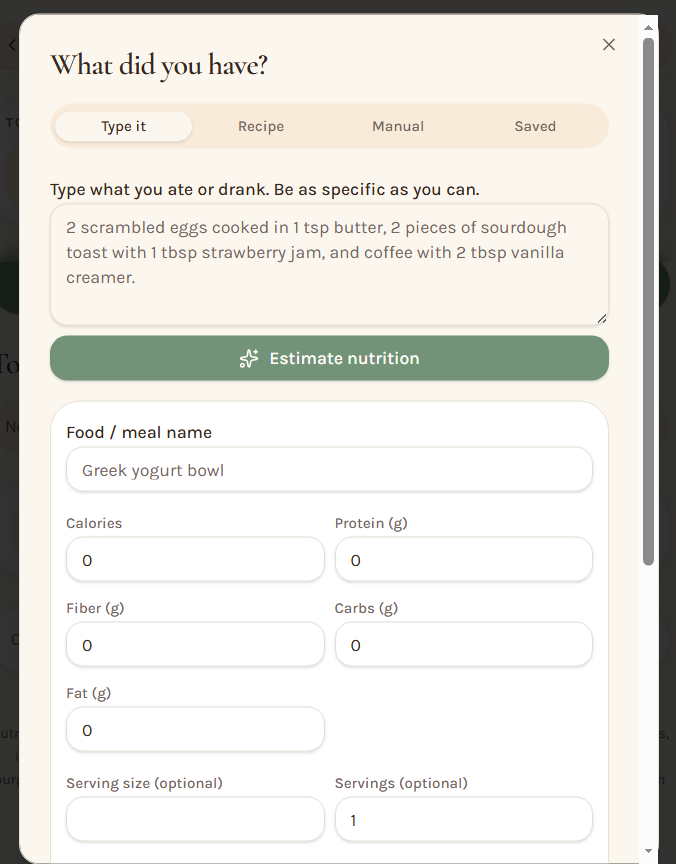
Try my simple food tracker tool instead
If an app like that isn't going to work for you and you'd rather just type in what you ate and have it generate and log it for you, I created this tool for you instead.
Just describe what you ate or drank, hit estimate, and it logs the nutrition for you — no database searching, no barcode scanning, no overwhelm.
 Open the food tracker →
Make it feel like a puzzle
Genuinely, it can get kind of fun:
How do I build a dinner I love and still hit my target?
How much protein did I actually get today?
What happens if I swap this sauce?
How can I make room for dinner out Saturday?
Tracking gives you data instead of judgment.
How to log a meal, simply
- 1Log the food.
- 2Choose the closest accurate serving.
- 3Adjust the quantity to what you actually ate.
- 4Check calories.
- 5Check protein.
- 6Check fiber.
- 7Review the whole day — don't obsess over one meal.
Track these too
- cooking oils
- dressings
- sauces
- coffee creamer
- drinks
- bites while cooking
- condiments
- nut butters
- cheese
- alcohol (outside the challenge)
Not forever
These six weeks are an opportunity to learn your food. After that, most people lean more on learned portions, familiar meals and body awareness. The goal is knowledge — not lifelong obsession.
If you have a history of disordered eating, please skip calorie tracking and use the approach your qualified clinician recommends. Every other promise still works beautifully without it.
Chapter 10
Build your plate
One picture, endless meals.
+ fiber-rich produce
Half the plate is vegetables or fiber-rich produce. A quarter is protein. A quarter is smart carbs — rice, potatoes, tortillas, pasta, bread. Then add healthy fats and actual flavor: olive oil, avocado, cheese, sauce.
Meals the whole family eats
You do not need separate "diet food." You need the same meal, portioned for you.
- chicken stir fry
- tacos
- burger bowls
- pasta with added protein
- sheet-pan meals
- taco salads
- chicken + potatoes + veggies
- breakfast for dinner
Chapter 11
How to measure your food
You don't need to be perfect. You just need to be honest enough to learn.
A food scale is your fastest teacher
A $15 digital scale removes almost all the guessing. Weigh food in grams when you can — it's more accurate than cups, spoons, or "about this much."
- Weigh food in the state you're logging it: raw or cooked, not both.
- Place your bowl or plate on the scale, then hit 'tare' to zero it out.
- Add ingredients one at a time, taring between each one.
- For packaged foods, scan the barcode and double-check the serving size.
- For meat, decide if you're logging raw weight or cooked weight and stay consistent.
Raw vs. cooked portions
This is where a lot of tracking quietly goes off track. Meat loses water when it cooks, so 4 oz of raw chicken becomes about 3 oz cooked. Rice and pasta absorb water, so 1/4 cup dry becomes roughly 3/4 cup cooked.
Meat
4 oz raw ≈ 3 oz cooked. Log whichever state you weighed.
Grains
1/4 cup dry rice ≈ 3/4 cup cooked. Pasta roughly doubles in volume.
Most tracking apps have separate entries for raw and cooked. Pick one and stick with it for that meal.
When you don't have a scale: hands + measuring cups
You won't always have a scale with you. Use these as a backup — they're good enough to keep you in the ballpark.
Palm
About 3–4 oz of cooked meat or fish
Fist
About 1 cup of vegetables, fruit, or grains
Cupped hand
About 1/2 cup of cooked grains or starchy veg
Thumb
About 1 tablespoon of oil, nut butter, or dressing
Two thumbs
About 2 tablespoons of cheese or dense fats
Hand portions are estimates — your palm is not the same size as mine. Use them as a guide, not a lab measurement.
Measuring cups and spoons
Great for liquids, powders, and anything that doesn't sit still on a scale. Level off dry ingredients — a heaping cup of oats is not the same as a level one.
- Use liquid measuring cups for milk, broth, oils, and dressings.
- Use dry measuring cups for oats, flour, rice, and pasta.
- Level spoons with a knife for nut butters, oils, and condiments.
- Pack brown sugar and shredded cheese only if the recipe calls for it.
You do not need to weigh every bite for the rest of your life. You just need to do it long enough to learn what a real portion looks like on your plate.
Chapter 12
Foods that work with your appetite
Some foods make staying in a deficit dramatically easier. Not magic — just protein, fiber, volume, slower digestion and nutrient density.
Protein-forward
- Greek yogurt
- lean meats
- eggs
- cottage cheese
- fish
Fiber + volume
- beans
- lentils
- leafy greens
- cruciferous veg
- high-fiber veg
Satisfying carbs & fruit
- berries
- potatoes
- whole grains
- fruit
- oats
Healthy fats
- avocado
- olive oil
- nuts (measured)
- seeds
The macros that matter most
The macros I want you to focus on — during the challenge and long after it ends — are your calories (especially while you're in a deficit), protein, and fiber.
Carbs and fats matter too, especially for energy and mental clarity. But protein and fiber are the two that make the biggest difference in how full you feel, how steady your energy is, and how well your body holds onto muscle while you're losing fat. Protein protects lean muscle, keeps hunger down longer, and has a higher thermic effect — meaning your body burns a little more digesting it. Fiber slows digestion, feeds your gut, and adds volume to your meals so you actually feel satisfied on fewer calories.
If you build every meal around a protein source plus at least one fiber-rich food, the rest tends to fall into place without obsessing over every gram.
A fiber note:
If you are not used to getting at least 25g of fiber a day, do not try to go from 5g to 35g overnight. Your gut needs time to adjust. Adding too much fiber too fast can leave you bloated, gassy, crampy, and running to the bathroom — which makes the whole "healthy eating" thing feel miserable fast.
The easy way: increase by about 5g every few days. Start with gentler, lighter-on-the-belly options like leafy greens, berries, zucchini, cucumbers, or a small sprinkle of chia or ground flaxseed. Then gradually add bigger fiber hitters like beans, lentils, cruciferous veggies, and whole grains as your body gets used to them. Drink plenty of water as you bump it up — fiber needs water to do its job comfortably.
You can start now:
You don't have to wait until Week 2 to add these foods in. If you want to get a jump on it, you can start adding more protein and fiber-rich foods during Week 1 while you're still tracking your current eating. Just track it honestly and let your body adjust.
A real day of eating — breakfast, lunch and dinner
These are not special diet meals. They're just what actually works in my real life — high protein, high fiber, and filling enough that I don't feel like I'm "dieting."
Breakfast
1–2 tbsp chia seeds in 1 cup nonfat Greek yogurt, mixed with 1/4 cup milk and 3/4 cup frozen wild blueberries. Let it soak in the fridge overnight for a 5-minute, grab-and-go breakfast. (Make 3–4 at once.)
338 cal · 30g protein · 12g fiber
Lunch
Half of a quesadilla: 1 Carb Balance tortilla, 3/4 cup or 3 oz of cooked ground beef or chicken breast, 1/4 cup black beans, 1/4 cup shredded cheese. Lean meat + fiber volume.
I always pre-cook 1 lb of ground beef and 1–2 chicken breasts a week so meals like this take minutes. You can also make several of these ahead and store in the fridge.
423 cal · 37g protein · 19g fiber
Dinner
15-minute teriyaki chicken stir fry: 1 lb chicken breast, 2 (12 oz) bags stir-fry veggies, 5–6 tbsp Kinder's teriyaki marinade sauce, served over 1/2 cup cooked 90-second jasmine rice. (I buy plain frozen stir-fry veggies, not the kit with the sugary teriyaki.)
I use 1 tbsp of extra virgin olive oil to cook the chicken, then remove the chicken and set it aside to cut up. I add another tbsp of olive oil to the pan and add in the veggies. Once they are steamed/sautéed and soft, I add the diced chicken back in with the teriyaki and let it sit on low for a few minutes.
511 cal · 49g protein · 3g fiber
Day total: 1,272 cal · 117g protein · 34g fiber
Carbs 105g · Fat 47g
All three meals are still way under my calories for the day, leaving me plenty of room for my protein coffee and a filling snack or dessert.
And notice: across just these three meals I already have at least 3 insulin- and hormone-supporting foods — chia seeds, cruciferous veggies, black beans, Greek yogurt, and lean proteins. That's the key. It doesn't have to be extreme, feel like a diet, or be complicated.
When you think about what to eat, just start with a protein source and one more hormone-supporting food or vegetable, then add carbs and healthy fats (cooking oils, eggs, avocado, etc.) around it.
Chapter 13
Meal timing + simple food hacks
- Don't under-eat all day and then arrive at 8pm ravenous — that's where most deficits go to die.
- Pick a meal rhythm that fits your actual life, not someone else's schedule.
- Spread protein across the day; it's easier to hit and keeps you fuller.
- A 10–15 minute walk after a meal can support post-meal glucose regulation — and it feels good.
Resistant starch, explained in 20 seconds
Cooking and then cooling certain starches — rice, potatoes, sweet potatoes — increases their resistant starch somewhat, meaning a portion is digested more slowly. Reheating can retain some of that.
Some of my go-to meals
My 21 Rotation Meals — with macros, instructions and swaps — live on their own page.
Open my Rotation Meals →Some of my favorite swaps:
- BBQ → G Hughes sugar free BBQ
- Flour tortillas → Carb Balance tortillas
- Teriyaki → Kinder's teriyaki marinade (and the sauce)
- Seasonings → I love ALL Kinder's seasonings — my basic necessity is "The Blend"
- Pasta noodles → Protein+ or protein pasta. PS: a 2 oz standard spaghetti serving is about 190–220 calories and makes 1 cup cooked — which is actually quite filling, especially topped with a lean protein. So yes, you can eat in a calorie deficit and still have spaghetti, especially if you pay attention to the sauces and add veggies and protein. Inside my rotation meals is my go-to pasta dish.
- Shredded cheese → fat-free or reduced-fat cheddar and mozzarella (averaging 45–60 calories per ¼ cup), or finely grated sharp parmesan and part-skim mozzarella
Chapter 15
The weekend trap
Five perfect weekday deficits can be quietly erased by two big weekend days. Not because weekends are evil — because two days is nearly 30% of your week, and nobody tracks the appetizer.
Your deficit is weekly, not daily
Your body doesn't reset at midnight. Fat loss follows the total of your week, not a scorecard of seven separate days. That's why one bigger day doesn't undo anything — and why one perfect day doesn't rescue a heavy week either. Zoom out and look at the seven-day total.
This is also your most useful planning tool. If you know Saturday night is dinner out, you can bank a little room ahead of time instead of white-knuckling it or writing the day off.
How banking works
- Save about 100 calories a day, Monday through Friday — a smaller pour of creamer, skip the handful of chips, one less slice of bread.
- That's 500 extra calories available on top of your normal dinner estimate on Saturday.
- Want more room? 200/day Monday–Friday = 1,000 calories banked, which covers a real dinner out with a drink and something shared.
Never bank by skipping meals or going under your floor. Trim edges, don't starve.
What actually works
- Plan ahead — look at the week and decide where the fun is.
- Track before you eat when it helps you choose.
- Pick the indulgences that genuinely matter to you and skip the ones that don't.
- Keep your normal meals — don't starve all day before dinner out.
- Enjoy the occasion without narrating your food choices to anyone.
- Return to normal at the very next meal. Not Monday. The next meal.
Chapter 16
Restaurant strategies
- Look at the menu ahead of time, before you're hungry and everyone is talking.
- Choose your protein first — it anchors the whole plate.
- Add vegetables where you can (swap, side, or as the base).
- Sauces and dressings on the side.
- Know that drinks can quietly out-calorie the entrée.
- Decide which indulgence matters most: the bread, the cocktail, or the dessert. Usually not all three.
- Don't arrive ravenous — a protein snack beforehand changes every decision you make.
- Enjoy the meal. Fully. That's the point of going.
- Track approximately when exact numbers don't exist. Close is useful; perfect is not required.
- Return to normal at the next meal.
You are learning how to have a life AND lose weight.
Chapter 17
My top weight loss tips
These are not another rule — just a suggestion.
1. Water + a high-protein breakfast before exercise or coffee
Water first, then a breakfast with 30+ grams of protein — before you move and before your coffee. Coffee on an empty stomach can spike cortisol, and cortisol on top of an already-empty tank tends to show up as jitters, cravings, and a crash a couple hours later.
Eating first steadies blood sugar, supports thyroid and sex hormones, protects muscle, and blunts the afternoon "I need something sweet" moment. Your coffee also just feels better.
2. Walking or bodyweight squats after every meal
After you eat, your blood sugar rises and your body releases insulin — the fat-storing hormone. Insulin's job is to move that fuel out of your bloodstream, and it will happily park the extra as fat.
Muscles that are working pull glucose in without needing much insulin. So 5–10 minutes of movement after a meal means a smaller blood sugar spike, less insulin, better energy, and fewer cravings later — which quietly makes your deficit easier to hold.
3. Ten minutes of sunshine in the morning + real sleep
Morning light sets your circadian rhythm, which sets your cortisol curve (high in the morning, low at night — the way it's supposed to be), boosts mood and vitamin D, and starts the clock on melatonin so you actually get sleepy at night.
Better sleep means better hunger hormones — more leptin (satisfied), less ghrelin (hungry), better insulin sensitivity, and more recovery. Poor sleep can make a perfect food day feel impossible.
4. Two to three insulin- and hormone-supporting foods a day — at least one per meal
This one is already a daily promise, but here it is explained properly. You are not adding a diet — you are adding a few ingredients to food you were already making.
- chia seeds
- ground flaxseed
- black beans + lentils
- berries
- leafy greens
- cruciferous veggies (broccoli, cabbage, Brussels)
- avocado
- extra virgin olive oil
- plain Greek yogurt or kefir
- salmon + sardines
- walnuts + almonds
- cinnamon
- apple cider vinegar
- eggs
Fiber, protein, and healthy fats slow how fast sugar hits your blood, so you need less insulin to handle the same meal. Less insulin floating around means your body spends more of the day in fat-burning mode instead of fat-storing mode.
Why this matters especially for women over 35: as estrogen and progesterone start shifting, insulin sensitivity naturally drops — the same meal produces a bigger insulin response than it did at 25. Muscle mass slowly declines (less storage space for carbs), cortisol runs higher, and fat starts settling around the middle. That's not a willpower problem, it's a hormone environment. Fiber-rich, protein-anchored meals are one of the most direct ways to change that environment.
Here is a day of real easy examples I eat regularly. They are high protein, high fiber, and filling enough that I do not feel like I am "dieting."
Breakfast
1–2 tbsp chia seeds in 1 cup nonfat Greek yogurt, mixed with 1/4 cup milk and 3/4 cup frozen wild blueberries. Let it soak in the fridge overnight. (Make 3–4 at once.)
338 cal · 30g protein · 12g fiber
Lunch
Half of a quesadilla: 1 Carb Balance tortilla, 3/4 cup or 3 oz of cooked ground beef or chicken breast, 1/4 cup black beans, 1/4 cup shredded cheese. Lean meat + fiber volume.
423 cal · 37g protein · 19g fiber
Dinner
15-minute teriyaki chicken stir fry: 1 lb chicken breast, 2 (12 oz) bags stir-fry veggies, 5–6 tbsp Kinder's teriyaki marinade sauce, served over 1/2 cup cooked 90-second jasmine rice.
I use 1 tbsp of extra virgin olive oil to cook the chicken, then remove the chicken and set it aside to cut up. I add another tbsp of olive oil to the pan and add in the veggies. Once they are steamed/sautéed and soft, I add the diced chicken back in with the teriyaki and let it sit on low for a few minutes.
511 cal · 49g protein · 3g fiber
Day total: 1,272 cal · 117g protein · 34g fiber
Carbs 105g · Fat 47g
None of these add time to my day. I'm already cooking and prepping meals — I just add certain foods. I'm already giving myself 10 minutes each morning just for ME, I just prefer to do it in the sunshine when I can. I'm already going to eat breakfast and have coffee — I just switched up the timing.
These aren't meant to take over your life. They're here to shed some light and support your hormones.
Chapter 18
Your walking method
The Layer Method™
We don't overhaul. We layer.
Each week builds gently on what you're already doing. No week asks you to become a different person overnight.
The walking method, in three moves
- Working your way up to 3 miles a day of intentional walking — not just steps you happen to get.
- Alternating regular walking with the 3-3 Momentum Walk™ (described below).
- Eventually adding in the Finish Line Five™ (also described below).
If you're not using a treadmill or walking pad, and you don't have a tracking device like a Garmin, Apple Watch or Fitbit, a free walking app is plenty. A couple of my favorites:
- MapMyWalk
- Google Fit
- Pacer
- Strava
Should I use a weighted vest?
You absolutely can — especially if you already use one. But do not feel like it's necessary. This challenge is built around consistency first, not extra equipment.
If you don't already use a weighted vest, the benefits are real: it can increase calorie burn, help preserve bone density, and make a regular walk feel a little more challenging without turning it into a workout you dread.
Here is my favorite one: Adjustable weighted vest on Amazon. It's adjustable and I started with 5 lbs, then added more weight each week as I felt stronger. Definitely get it with the shoulder pads.
Walking is the foundation — more consistent movement is the goal. That's why the Morning Reset™ and Exercise Snacks are here too. You do not need a gym, dumbbells, or another half hour blocked out of your day. The Morning Reset™ is only 7–10 minutes, and Exercise Snacks fit into tiny pockets: while you're brushing your teeth, bathing your kids, making dinner, taking out the trash, on a bathroom break at work, or at your desk. They take 1–2 minutes max, but they help you preserve muscle and burn more calories all day long.
Morning Reset™
Ten minutes of gentle, joint-friendly movement filmed by me. It's relaxing on purpose — easy circulation, a little mobility, working through morning stiffness, and getting reacquainted with your body before the day starts. No jumping, no equipment, nothing that needs a floor routine you dread. It's not a workout you have to survive — it's how you get your body moving before the day starts asking things from you.
You don't have to remember it or piece it together yourself. The Morning Reset™ is already filmed and waiting inside your challenge app. Whenever it shows up on your schedule, just press play and follow along — and you can come back to it any morning you want throughout the challenge, even on rest days.
Before the day starts asking things from you, these 10 minutes belong to you.
Exercise Snacks
Tiny bursts of movement sprinkled through your day. Thirty seconds here, a minute there.
- overhead marches
- squats
- calf raises
- countertop push-ups
- marching
- step-ups
- lunges (if they feel good)
- side steps
Finish Line Five™
A short ritual at the end of designated walks. The exact movements live inside your challenge app. The purpose is bigger than the movements:
I finished what I started.
The 3-3 Momentum Walk™
This is interval walking — often called the Japanese interval walking method. The rhythm is beautifully simple: 3 minutes easy, 3 minutes brisk, repeated for about 30 minutes. No running, no equipment, no complicated plan.
3
minutes easy
Comfortable, conversational pace — recover.
3
minutes brisk
Purposeful, slightly breathy — still in control.
Alternate back and forth for the duration your app assigns (usually around 30 minutes).
Why this method works
- Better fitness: improves aerobic capacity and VO2 max
- Blood sugar control: helps manage glucose levels and lowers blood pressure
- Joint friendly: low impact compared to running or high-intensity training
- Time efficient: real cardiovascular rewards in about 30 minutes
- Makes a familiar walk feel new again — and teaches you what effort levels feel like
Intermediate may use 3-3 Momentum Walks every other walking day, as assigned. Beginner introduces them later and less often.
Chapter 19
Your Comfortable Cardio Zone
An estimated moderate-effort walking range — the pace where you're working, but still you.
Read this first
This chapter is here for knowledge — it's useful if you wear a tracking device like an Apple Watch, Fitbit or Garmin and want to know what those heart rate numbers mean. If you don't wear one, follow the Talk Test below instead. You do not need to buy a tracking device for this challenge.
Enter your age to see your estimated range.
The Talk Test is your simplest tool.
In this zone you should be able to talk in sentences or short phrases. You feel like you're working — but you're still in control.
Why this range is lower than most calculators tell you
Most heart-rate charts are built for training athletes, so they push you into ranges you'd only reach by running. We're not doing that. This range is set for steady walking — the effort where you burn real calories, mostly from fat, without spiking cortisol, wrecking your recovery or leaving you ravenous.
If you're walking at a solid pace and your heart rate sits in the 110s–120s, that is not "not enough." That is exactly the zone. Please don't start running to chase a number. The walk you can repeat tomorrow beats the workout that costs you three days.
A quick note on the math: this uses a more realistic max heart rate (208 − 0.7 × your age) instead of the old 220 − age, and a walking-appropriate intensity window. Even then, real bodies vary — fitness, medications, hydration, heat and caffeine all move the number.
So use this as knowledge, not a rule. If you wear an Apple Watch, Fitbit, Garmin or anything else, glance at it during walks and learn where you naturally sit at a strong, comfortable pace. That's your zone — even if it lands a little below the estimate.
Chapter 20
Before you begin
These are not judgments. They are data. Six weeks from now, you'll be glad you wrote them down.
Body
Measure first thing in the morning if you can. Same time, same conditions, both times.
Current habits
Best guess is fine. This is a starting line, not a test.
How I feel
1 = very low, 10 = very high. Honest, not hopeful.
Reflection
Your answers save automatically on this device and stay on this device.
Chapter 21
Get started checklist
Everything to do before day one — so day one feels calm instead of chaotic.
Read this whole guide first
Every chapter builds on the last one. Skim it again if you need to — day one goes so much smoother when nothing surprises you.
Fill out your Beginning Assessment
Measurements, habits and how you feel right now. Future you will be so glad it's written down. (Chapter 19 right before this under "before you begin".)
Take your before pictures
For you only, or to share with us as you go — whatever you're comfortable with. Front, side, same lighting, same spot.
Download and set up your tracker apps
Food: MyFitnessPal (or ChatGPT if you'd rather talk it out). Walking: MapMyWalk, Google Fit, or your Apple Watch, Fitbit, Garmin or walking pad.
Grab your favorite water bottle
Fill it tonight and set it where you'll see it first thing. 100 oz is so much easier when you love the bottle.
Open your challenge app and plan day one
Pick your challenge in the next chapter, then look at day one so you already know what movement is waiting for you. (Chapter 21.)
Screenshot your daily 8 Promises list
It's just below the challenge links — save it to your phone so you can check back in throughout the day. (Chapter 22.)
Then take it one day at a time
You don't have to plan week four today. Today only needs today.
Remind yourself you've got this
This was never about being perfect. It's about showing up for you again — and you're already doing it.
And actually have fun with it
This is not one more chore on your to-do list. This is your 10 minutes of quiet, your walk in the sunshine, your favorite playlist, your dinner that tastes amazing and still fits. You're not punishing yourself for six weeks — you're finally taking care of yourself, and that gets to feel good.
Chapter 22
Choose your challenge
Both paths use the same promises. They just start in different places.
Beginner
Getting back into it
For women who haven't been exercising consistently, are rebuilding after time away, or want the gentlest possible progression toward regular walking.
START BEGINNER CHALLENGE →Intermediate
Ready for more
For women already averaging roughly 5,000+ steps or walking somewhat consistently, who want more progression, challenge and structure without a traditional gym program.
START INTERMEDIATE CHALLENGE →Chapter 23
Screenshot this
Save it to your phone. Set it as your lock screen if you want.
The 8 Promises
- 100 oz water
- No sugary drinks/creamers
- No alcohol
- Stay in my calorie deficit (starts week 2)
- Eat 80% whole foods + supportive foods
- Complete today's movement
- Take 10 minutes for me
- Respect 2 rest days/week (1 weekend, 1 weekday)
You don't have to do this perfectly. You just have to keep showing up.
Chapter 24
End of 6 weeks — return here
Come back after Week 6
When you finish, come back here and fill in the same measurements, habits and sliders. Then the Playbook builds your before-and-after for you.
Chapter 25
Your 6-week transformation
Resources & Tools
My favorite resources and tools
The things I actually use, recommend, and share with the people I coach.
On the go
Fast Food Cheat Sheet App
I know life gets busy, so here is probably one of my favorite “on the go” tools when you need to make a quick choice that still fits your goals.
Open the cheat sheet →Education
The Metabolic Reset
The reset that helps you finally understand why your body changed and what you can do to fix it without dieting or over-training.
Shop the reset →Movement
Walking Pad
My go-to walking pad for getting in intentional steps at home when the weather or schedule doesn't cooperate.
View on Amazon →Movement
Adjustable Weighted Vest
Adjustable, comfortable, and worth getting with the shoulder pads. I started with 5 lbs and added weight each week as I felt stronger.
View vest on Amazon →Recovery
Magnesium Glycinate
A gentle, well-absorbed form of magnesium that supports sleep, recovery, and muscle relaxation without the digestive drama.
View on Amazon →Hydration
Instant Hydration (premium electrolytes)
My favorite electrolytes — especially helpful if you're increasing water, walking more, or live somewhere warm.
Shop Instant Hydration →Self care
Kitsch Self Care Favorites
A few of my favorite self-care finds — because taking care of yourself should feel good, not like another chore.
Shop Kitsch →Tracking
Your Simple Food Tracker
Rather type what you ate than hunt through an app? This tool estimates and logs nutrition for you — no barcode scanning required.
Open food tracker →